Seagulls & Proofing
| Bird Control |
|---|
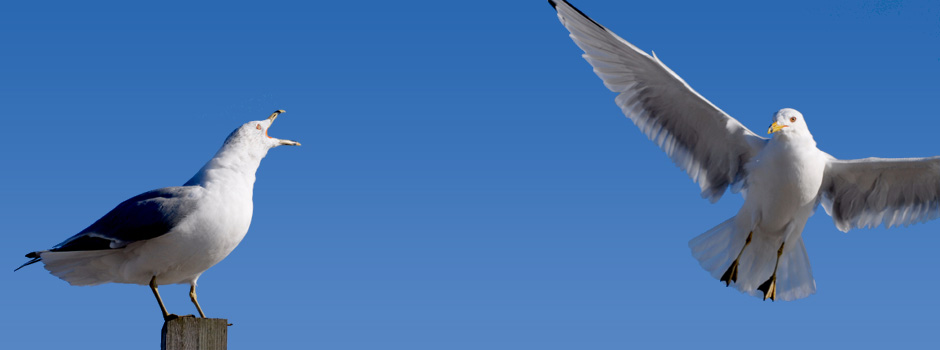
The Control Of Nesting Gulls Nesting by gulls on roofs on domestic + commercial premesis is a fairly recent phenomenon, and colonies are now commonly found in many towns and cities. There are several species of gulls which can be seen locally and to many people they are just seagulls, but in our area only the lesser black backed and herring gulls commonly nest on buildings. The Problem Many people who have gulls on their property find they cause a nuisance; commonly cited problems include:
Natural History Herring gulls are large birds. Mature birds are on average about 55cm (22") from bill to tail with a wingspan of about 85cm (34"). They have silver / grey wings and pink legs. Lesser black backed gulls are usually slightly smaller. Adult birds have a slate grey back and yellow legs instead of pink legs. Both species begin mating in April and commence nest- building from early May onwards. In towns, the nest is constructed from straw and grass, twigs, paper and any other material the gull can conveniently use. The nest can be quite large and, if made of material accumulated over several years, very heavy. Eggs are laid from early May onwards with two or three being the usual number. The eggs take about three weeks to hatch so the first chicks are generally seen about the beginning of June. The chicks grow quickly but generally do not leave the nest for 5-6 weeks and are quite active. They often fall from the nest and in towns this will almost certainly mean they cannot return to the nest. Chicks generally begin to fly in late July early August and then take normally four years to reach maturity and breed. Gulls and the Law There are, however, powers available to the Council and others to take action and these are explained in this section. The purpose of this section is to provide advice on the law but it is a guide only and is not meant to be authoritative. The principal legislation dealing with the control of birds is the Wildlife and Country Act 1981. Generally, it is illegal to capture, injure or destroy any wild bird or interfere with its nest or eggs. The penalties for disregarding the law can be severe. The law does, however, recognise that particular species of common bird, such as herring and lesser black- backed gulls, can cause nuisance and allows measures to be taken against such birds in limited circumstances. Action can only be taken under general licences made under the 1981 Act for the purpose of preserving public health or public or air safety, preventing the spread of disease or for preventing serious damage to livestock, foodstuffs for livestock, crops etc. An offence would be committed if action could not be justified or defended for any of these purposes. Only the owner or occupier can take action against gulls nesting on their buildings, or they can give someone else permission to act on their behalf. Any action taken must be justified in terms of the law and can include:-
Action taken must be humane. Any inhumane method which could cause suffering would be illegal. The use of poisons or drugs to take or kill any bird is specifically prohibited except under very special circumstances and with a government licence. In practice, there are very few humane methods to kill birds which are likely only to affect that particular species and skill and experience is needed to deploy them. The Council is particularly keen to discourage shooting of gulls. Culling There is no universal opinion among the experts that a large scale cull of gulls would be effective. Indeed some believe that the gull population in the towns is different from that of local land fill sites and there is documented evidence to indicate that this is the case. Nest removal Nests could be removed, however, this would have to be repeated a number of times during the season as the gulls will rebuild their nest very quickly if it has been removed or destroyed. Egg removal Eggs could be removed from nests, however, this would have to be repeated a number of times during the breeding season as they will be replaced once they are found not to be viable by the parent birds. NOTE Egg oiling The treatment of gulls eggs , with liquid paraffin BP offers a cheap and efficient way of preventing hatching. If done correctly and at the right time of year, this technique is 100% effective in preventing the hatching of eggs. Disturbance of Birds There are a variety of methods of disturbing or discouraging birds from particular locations including birds of prey, bird scarers etc. For areas within towns none of these methods are successful in the long term. Proofing Methods of proofing buildings include the use of spikes, nets or wires. This is the only sure method of preventing birds from nesting on buildings. Education It is vital that the public are made aware that gulls are attracted to areas where food is plentiful. Gulls are opportunistic and will scavenge waste bins and look for food from the public. Deterrence All owners/ occupiers of buildings which have, or may attract roof - nesting gulls are strongly urged to provide the building with deterrent measures suitable to the individual building. This section describes some of the measures available.
The basic methods of use are as follows:- Chimney - back fixing / top fixing Gulls sometimes nest behind chimney - stacks where the chimney meets a sloping roof. The valley formed is often warm and sheltered from the wind and makes an ideal nest site. It is difficult to place spikes at the base of the valley formed because the fixing can interfere with the structure of the roof. The usual fixing method is to screw onto the chimney using a masonry plug and screw with a stout washer to secure the spike against the masonry. The surface to be treated, usually the cement flaunchings between the chimney - pots, should be brushed clean with a wire brush. The spikes are then bent into the required shape and placed in position on a dab of mortar. A further dab of mortar is then used to secure the spike assembly. The use of a PVA compound can assist adhesion of the mortar to the chimney stack. Wiring and Netting CALL NOW 08007313647 |